%202026.png)
Motion as Medium: Why the Future of Business Space Moves
- Gueston Smith
- Dec 11, 2025
- 6 min read

Updated: Dec 11, 2025
Motion creates sensation. Sensation creates emotion. Every sensory input is vibration translated into experience.
Every experience you’ve ever had...
Every sensation.
Every memory.
Every moment of awareness.
Entered your nervous system through motion.
ENERGY in motion elicits EMOTION.
Sight: light striking your retina: electromagnetic waves in motion.
Hearing: sound reaching your ear: air molecules in motion.
Touch: mechanical pressure in motion.
Taste & smell: molecules in motion.
Without senses, there is no experience. Nothing for us to feel. Nothing to be consciously aware of. The nervous system doesn't detect stillness. It perceives variation. Change. Vibration. Even time is understood through motion. The law of vibration. Nothing is truly at rest. What happens when we put environment in motion?
This reveals something profound about the work we’re building at Guesscreative.
The Static World vs. A Reality Constructed with Motion
When business space moves, it follows opportunity rather than waiting for it.
Traditional real estate has its vital place in our society but it operates on an illusion that permanence equals value. Fixed buildings anchored to foundations are vital for structure, shelter and security, but they contradict the most fundamental law of existence: everything moves, everything vibrates, nothing rests.
Life moves:
Blood circulates
Neurons fire
Cells divide
Thoughts shift
Culture evolves
Markets fluctuate
Human attention migrates
Communities reorganize
Opportunity relocates
To only build static structures for dynamic beings is to design for stillness in a universe that never stops moving.
Static architecture has influenced, inspired and protected human beings since the dawn of time. Necessary for that use case, absolutely. But I question, how has architecture continued to adapt and evolve to the needs of human progression?
Movable space is not a new concept. I understand this.
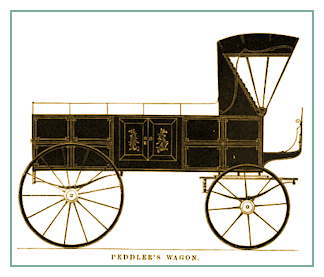
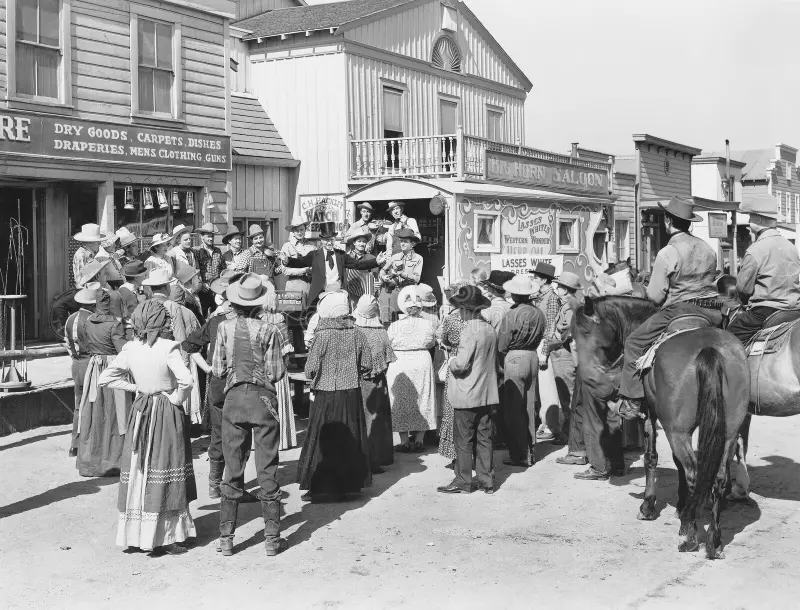


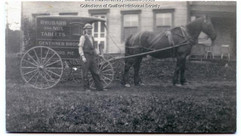
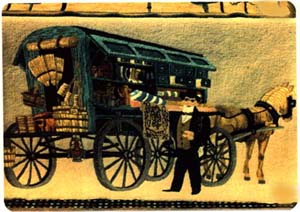
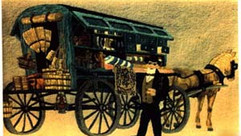



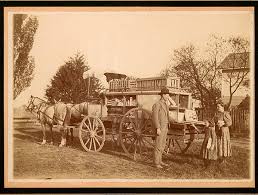

A 19th-century Peddler's Wagon generating cultural activation. Historical Precedent.
Way before experiential trailers, long before pop-ups, long before brand activations, there was the 19th-century Peddler Wagon. This was the original mobile department store. This was the ancestor of the modern mobile retail movement. It was a curated micro-store with hinged sides that folded down like a stage. It had shelving, drawers, cubbies for merchandising. It even had lockable compartments and hidden “false floors” to store cash & gold. Peddlers sold items that families couldn’t make. The clatter of tin cups banging against the wagon was early audio branding, a soundscape announcing “the store has arrived” similar to how we perceive the ice cream truck. The peddler wasn’t just a retailer. He was a messenger, a news source, and an entertainer that connected isolated homesteads to the global economy. The wagon brought connection as much as commerce.

A 19th-century mobile asset generating cultural activation. Notice the crowd. Arrival creates engagement.
Movable Space as Vibrational Infrastructure
Nikola Tesla said, "to understand the universe, think in terms of energy, frequency & vibration." When we design a mobile business trailer, we're not just creating a space that moves. We're creating a traveling field of stimulus, a relocatable generator of sensory experience that can reposition itself in relation to market demand, cultural moments, seasonal patterns, and entrepreneurial opportunity.
Each Guesscreative unit functions as:
A Perceptual Instrument: It arrives, and the environment changes. Novelty triggers attention. Attention triggers dopamine release. Dopamine release drives engagement. The space doesn't just house commerce, it generates it through controlled sensory modulation.
An Adaptive Organism: Unlike fixed retail that waits for customers to find it, an entrepreneur with a mobile asset goes to the energy. They read the vibrational frequency of a market and position themselves accordingly. This is biological intelligence applied to architecture.
A Cultural Neuron: Just as neurons extend consciousness through the body by transmitting signals, movable spaces are relocatable environments that extend experiential consciousness through society by transmitting opportunity, access, and activation.
Imagine what an ecosystem of movable spaces can do for the free market.
An ecosystem of motion. What happens when commercial spatial infrastructure operates like this? Distributed, adaptive, continuously flowing?
The Movable Asset Advantage: Four Vibrational Principles
1. Resonance With Natural Law
The universe operates on motion. Electrons orbit. Planets rotate. Galaxies spiral. Blood flows. A movable business asset aligns with this fundamental principle. It doesn't resist change, it is change. It doesn't fight evolution, it embodies it.
This creates inherent resilience. What moves can adapt. What adapts survives.
2. Perceptual Refresh
The desire to live allowed the brain of most organisms to evolve to detect movement. Fixed objects are less of a threat to existence. Static environments fade into background. Arrival creates salience.
When your mobile tasting room pulls up to a vineyard, when your athlete training trailer appears at a tournament, when your wellness pod activates a neighborhood, you're generating neurological impact just from the act of arriving alone.
It's something new.
It's something interesting.
It's something engaging.
You're not just delivering a service. You're delivering a sensory moment.
3. Distributed Scalability
Businesses want to scale but traditional expansion means build more fixed locations, multiply overhead, and take lose capital to build out costs. With a movable asset, a business can deploy more vibrational nodes into the field, multiply revenue streams, distribute opportunity, and create excitement.
One entrepreneur with multiple mobile units can occupy ten cities simultaneously. Ten entrepreneurs with one unit each can activate ten neighborhoods daily.
This is exponential reach without exponential burden because motion creates multiplicity.
4. Energetic Imprint
A movable space doesn't just occupy territory, it imprints it.
It arrives. Creates experience. Generates memory. Departs. And the environment is permanently changed by the interaction because those who experienced it will be eager for the next time it returns.
Like a stone dropped in water, each mobile asset can send ripples through the cultural fabric with the formation of new relationships, the initiation and distribution of new commerce, and imagination of new possibilities to activate in opportune areas.
The Economic Translation
The vibrational framework produces measurable economic advantage.
Movable assets:
Enable ownership instead of perpetual lease liability
Reduce customer acquisition cost through strategic positioning
Enable market testing without permanent commitment
Increase revenue-per-square-foot via adaptable density
Hold value as owned assets instead of sinking into overhead
Appreciate through upgrades instead of depreciating through wear
Inform strategic decisions on where to place permanent locations
Stillness is for strategy. Motion is performance.
Building the Vibrational Economy
Guesscreative isn’t manufacturing trailers. We are created a distributed nervous system for opportunity and entrepreneurship.

Guesscreative Spatial Opportunity Map reveals the highest-value locations across DFW and the U.S. for mobile business trailers from high-traffic retail zones to vendor-friendly parking lots and farmers markets.
Each mobile space acts as a cultural and commercial signal generator:
Athletes can create movable training ecosystems
Educators can bring S.T.E.A.M experiences to underserved communities
Wellness practitioners can activate neighborhoods
Retailers can scale without long term leases
Creators can build an audience through consistent presence across geographies
In a free market, the units form an ecosystem of motion that lives, breathes and cultivates a network of spaces that pulse with human intention, economic activity, and cultural evolution.
This is Spatial Entrepreneurship: the understanding that space itself can be entrepreneurial when it moves.
The Deeper Implication
If consciousness perceives through motion,
and Guesscreative creates environments designed to move,
then we're not just building businesses, we're designing tools that modify human experience at the neurological level.
Your mobile tasting room doesn't just serve wine. It alters the vibrational state of everyone who encounters it through the senses. Orchestrate multisensory experiences that travel. Movable assets have the potential to feel more alive than static buildings because they introduce motion into our everyday environment, and motion is the language of life itself.
The Vision Forward
As we scale Guesscreative, we're not just growing a design philosophy.
We're pioneering vibrational infrastructure for the next economy, one where:
Entrepreneurs own their spaces instead of renting fixed locations
Communities access opportunity through mobile activation
Culture distributes through traveling nodes rather than centralized hubs
Revenue generation follows human motion rather than fighting it
Every unit we design is a vote for mobility over stagnation.
Every entrepreneur we empower is a vote for adaptation over constraint.
Every community we activate is a vote for distributed access over centralized control.
We're building the future of space itself and the future moves.
Follow the evolution of Spatial Entrepreneurship at guesscreative.com or connect with me on LinkedIn.
Gueston Smith
Founder, Spatial Entrepreneur
Author Bio: Gueston Smith is the founder of Guesscreative, a Dallas / Fort Worth-based design studio specializing in premium mobile business infrastructure. With a degree in Architecture from USC and 11 years of multidisciplinary design experience, he has delivered over $180K in custom movable assets and pioneered the Spatial Entrepreneurship framework.


Comments