
Designer Develops Concept for a Mobile Batting Cage on Wheels (Investment Opportunity)
- Gueston Smith
- Mar 20, 2023
- 5 min read

Updated: Apr 23
In researching ideas for mobile experiences, I came across HitTrax. This company is great because they develop batting cage simulators. Seeing the batting cage immediately awakened my inner child and had my my mind racing in thinking of the possibilities of what could be developed. I'm not sure if you've ever heard of Putt-Putt but I used to go there a lot as a child. For a young child, Putt-Putt was amazing because they had seemingly unlimited arcade games, mini-golf, go-karts and batting cages, all in one place. It was an oasis for an active kid. I loved the batting cages. I can still feel the slightly sticky rubber grip on the aluminum bat and the blisters that I'd get from hitting the baseballs all over the cage. Ironically, the cage was freeing because it was a space where I swing as hard as I could without the concern of causing damage to a neighbor the thought of embarrassment if I missed. It was okay to miss so that made it even more exciting to get a clean hit. It tested my hand-eye coordination...which I valued. I still do.
Discovering HitTrax made me wonder...What could a mobile batting cage looking like?
First, Let's see what a batting cage simulator looked like.

As you can see, The batting cage is a long rectangular shape which is perfect for a mobile setup. Knowing this, I engaged with HitTrax to see what is involved in their offering. Here is what would be included in their setup:

HitTrax Suite Simulator
High Impact HitTrax Frame
Infrared High-Speed Cameras
Infrared LED Sources
(1) Dell All-In-One Touch Screen, 24”
(12) month warranty included after date of installation
Lexan Protective Cover for Sensor (Overhead Configuration Only)
HitTrax Suite Software
HitTrax Suite Projector Package
Hi-Impact Custom Projector Screen
Single Cutout for Pitched Balls
7000-Lumen LCD Projector
Custom Overhead Projector Protective Guard
All hardware and mounting accessories included
HitTrax Suite Pitching Machine Package
Supports foam and real Baseballs
Built in feeder (72-ball max capacity)
6-Dozen Featherlite Baseballs
Fully integrated with HitTrax Software
Batting Mat


I was determined to find a way to fit their product into a trailer space. Imagine the potential of having a batting cage that can be rented out for events, parties and even just flexible to be relocated amongst training facilities for high school, college & professional athletes.
See the design drawings below:
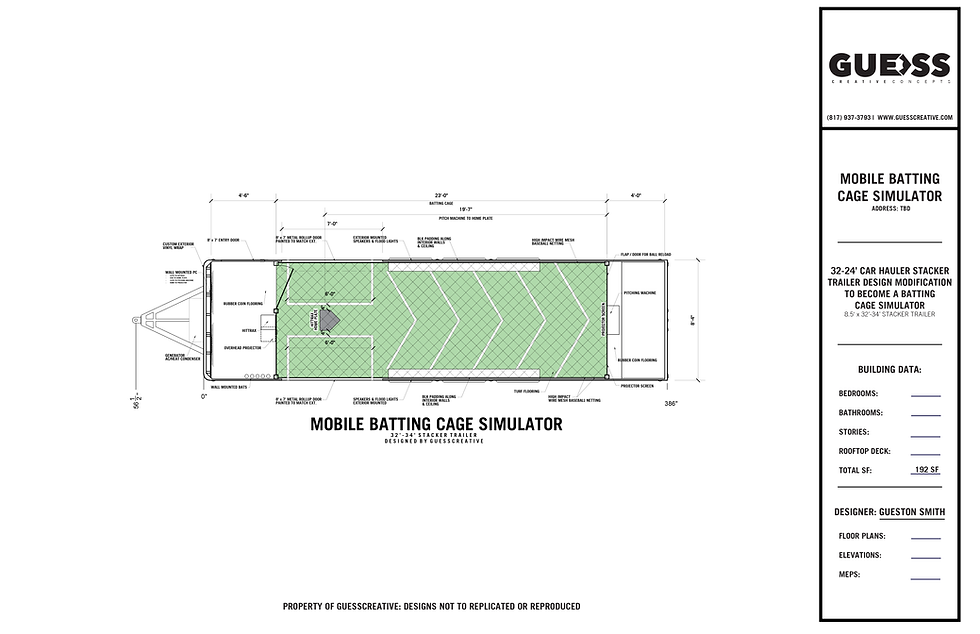
For the mobile batting cage simulator trailer, a stacker trailer would be used. I believe that any trailer over 28' would be feasible but I strongly recommend at least 32'-34' for adequate space.
The approach would look like this:
A New batter comes into the trailer, logs into the HitTrax system, grabs a bat from the wall and walks into the cage. The batting cage is designed to be an experience. The lights on the ground light up to direct towards the projector screen which shows the outfield. The pitching machine would poke through the projector screen and the walls would be covered with Black padding so that the baseballs don't damage the unit and the sound would be suppressed.

At first glance, this seems like a packaging problem. Fit the cage into a trailer and you are done. That is not the real challenge.
A mobile batting cage is a deployment system.
The real problem lives in the transition between transport, setup, operation and teardown. If the system takes too long to deploy, requires multiple people, or breaks down under repeated use, it fails as a business regardless of how impressive it looks.
The design must account for movement, repetition and time.
There are two primary ways to build a mobile batting experience.
Fully enclosed simulator
This is the trailer-based system shown above.
Controlled environment
Integrated technology such as HitTrax
Premium experience
Higher cost and higher perceived value
Best suited for bookings, training and branded activations
Deployable cage system
In this model, the trailer acts as a base and the cage extends outward on site.
Larger potential hitting distance
Faster deployment if designed correctly
Lower cost relative to full enclosure
Better for tournaments, parks and high-volume environments
The right approach depends on how the unit is expected to generate revenue.
Below is an example direction for a deployable mobile batting unit.

This approach focuses on a fully integrated structure mounted to a towable chassis. The goal is not just mobility, but operational simplicity. The entire system remains intact during transport, allowing for fast setup on site without assembly.
Key considerations in this direction:
Clear batting lane with defined entry and exit
Integrated lighting for night activation and visual impact
Durable framing for repeated transport and use
Compact footprint for towing with full expansion on site
The next phase of development is not aesthetic refinement. It is operational refinement.
Where does the operator stand
How quickly can users cycle through
How the system handles continuous use
How this unit can be replicated without redesign
This is where the difference between a one-off build and a scalable product is defined.
Most mobile concepts fail in designing for the operator.
The focus tends to be on the athlete experience, but the operator determines whether the business survives.
Key questions:
Can one person set it up in under 15 to 20 minutes
Does the system stay integrated during transport
How many users can realistically cycle through per hour
How does it handle repeated movement, loading and weather
A successful mobile system is designed around the operator first.
The athlete experience follows.
It is easy to assume a flat hourly rental model, but that is rarely how these systems perform best.
Operators often use:
per swing pricing
short session pricing such as 5 to 10 minutes
flat event bookings
Example:
6 to 10 users per hour
10 to 20 dollars per user
60 to 200 dollars per hour depending on format
The real driver is not the price per hour. It is how quickly users can move through the system without friction. Throughput is a design decision.
From one unit to a network
The real opportunity is not a single mobile batting cage.
It is a repeatable system.
If the first unit is designed correctly, it becomes a template that can be duplicated across markets. This is how mobile experience companies scale.
standardized builds
consistent user experience
predictable deployment
The first unit is not just a project. It is the foundation for replication.
Cost considerations
Cost varies significantly depending on the system.
Deployable cage systems typically range from $75K to $105K dollars
Fully enclosed simulator trailers typically range from $150K to $250K+ dollars or more
The difference comes from enclosure, technology integration and mechanical systems, not just size.
The question is no longer whether a mobile batting cage can be built.
The question is whether it can be deployed, operated and replicated profitably.
That is where design becomes strategy.
And that is where Guesscreative operates.


Comments